

RESEARCH PROJECTS
Nature and led based rain water treatment for reuse in green cities (LIFE GreenLED)
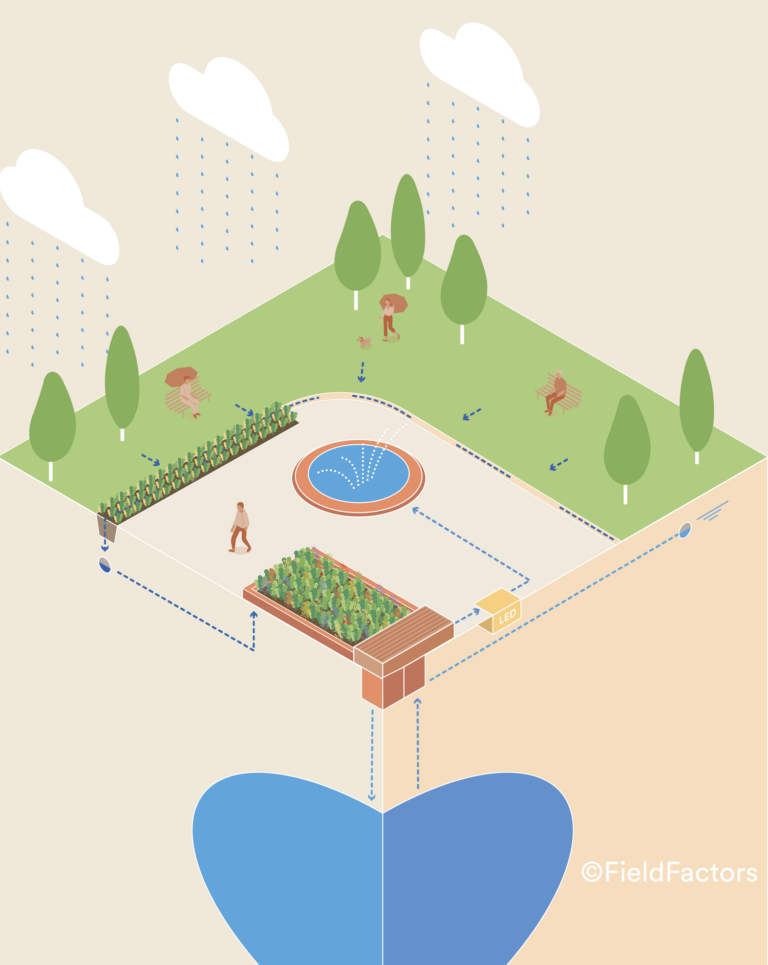
Within the LIFE GreenLED project, two full-scale demonstrations of biofiltration and phytoremediation treatments coupled with UVC-LED technologies will be installed, to guarantee disinfection and carry out the treatment of bio-recalcitrant emerging contaminants from rainwater collected in the implementation zone for its reuse in different urban applications. Two demonstration sites will be implemented: one in the Eastern Development – Los Ahijones de Madrid (Spain) and another in Alphen aan de Rijn (Netherlands), where a considerably significant amount of litres of drinking water can be saved. The project will demonstrate that rainwater can be a reliable water source to meet the growing demand of water in cities, and thus address water scarcity issues. In this way, the project will have a great impact, both in the climate protection of urban environment and in the saving of drinking water.
PROJECT DATA
Participating entities
TU Delft (Netherlands), Field Factors (Netherlands), APRIA Systems (Spain), Alphen aans de Rijn (Netherlands), Eastern Development Compensation Board – Los Ahijones de Madrid, Polytechnic University of Madrid
Financing Entity
European Union
Program
LIFE
UPM Budget
€339.091
Period
From 07/01/2023 to 06/31/2027
UPM RESEARCHERS
Daphne Hermosilla (IP), Antonio Gascó, Francesca Olivieri, Noemí Merayo, Margarita Martínez
URBRAINTREAT: Efficient urban stormwater management and treatment strategies for the development of resilient and sustainable cities
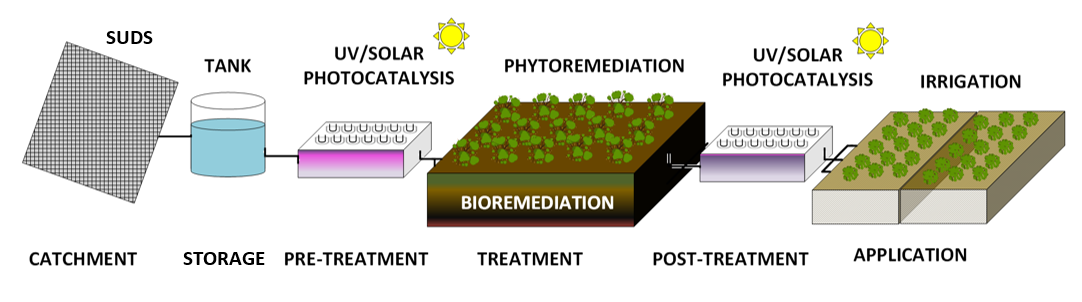
Today’s cities are far away from being resilient in water management, control of runoff and flooding events, and drought mitigation. Research about decentralised solutions for water management and treatment, including green infrastructure for rainwater harvesting and treatment, can provide an additional source of usable rainwater supply, implying important benefits such as lower heat levels in the cities, flooding reduction and growing of urban green infrastructure, including urban agriculture. The application of nature-based solutions (bio- and phytoremediation) has proven to be a possible solution for wastewater management in many situations, but it is necessary to develop more research with the objective of consolidating its implementation potential. In particular, the combination of these technologies with photocatalytic processes, can be crucial to ensure the elimination of bio-recalcitrant compounds and pathogens presence. The main hypothesis of this proposal is that urban rainwater could be collected and decontaminated efficiently trough feasible treatment strategies, combining nature-based technologies with photocatalytic treatment with the aim of meeting water quality requirements for a series of applications that replace the use of drinking water.
PROJECT DATA
Participating entities
Polytechnic University of Madrid, ICP-CSIC, University of Extremadura, IT Sligo (Irlanda), University of Trieste (Italy)
Financing Entity
Ministry of Science and Innovation
Program
Knowledge Generation Subprogram of the State Plan
UPM Budget
€193.600
Period
From 09/01/2022 to 08/31/2025
UPM RESEARCHERS
Antonio Gascó (IP), Francesca Olivieri, Noemí Merayo, Carlos Calderón
Instruments for the Transformation of existing neighbourhoods into Positive Energy Districts (PEDs) in the framework of Energy Transition of Mediterranean Climate Cities.
The general objective of the project is to develop design tools that facilitate the transformation of existing neighbourhoods into Positive Energy Districts (PEDs) in the framework of energy transition of cities with mediterranean climate. To this end, the aim is to develop instruments that include active and passive solutions for buildings and their surroundings and whose users are the residents of the neighbourhood themselves. The first objective of the project consists in designing an integrative methodology that gives place to a tool aimed at citizens, for decision-making in the transformation process of existing neighbourhoods into PEDs. The second objective is to develop a scalability model of the methodology, demonstrating that PEDs combination will allow to advance towards energy transition at city level.

PROJECT DATA
Participating entities
Polytechnic University of Madrid, Università degli studi di Bologna (Italy), R2M, Alcorcón City Council
Financing entity
Program
Aids to carry out R&D Projects for young investigators of Polytechnic University of Madrid 2022
UPM Budget
€40.000
Period
From 07/01/2022 to 06/30/2024
UPM RESEARCHERS
Francesca Olivieri (IP), Lorenzo Olivieri, César Bedoya Frutos, Álvaro Gutiérrez Martín, Sonia Roig Gómez, María Josefa Cassinello Plaza
eNeuron: GreeN Energy HUbs for Local IntegRated Energy COmmunities optimisation
Using the energy centre concept, eNeuron will develop a set of pioneering tools for the optimal design and operation of multi-carrier energy systems. To achieve this, we will draw a map of regulatory and technical bottlenecks with the existing LEC, before building new use cases and business models for use at different scales. They will rely on the latest hardware and software solutions, including a management platform based in the cloud to dynamically balance supply and demand of multiple energy suppliers. Once refined, the eNeuron LEC framework will be tested in four pilot projects: a city and its main energy nodes (Bydgoszcz, Poland), a football stadium and its surroundings (Skagerak, Norway), a navy district with its own distribution network (Lisbon, Portugal) and a university campus in several locations (Ancona, Italy). The general objective is to verify the effectiveness and replicability of the tool as a concepts and solution for different local contexts.

PROJECT DATA
Participating entities
Polytechnic University of Madrid
Financing entity
H2020
Program
SOCIETAL CHALLENGES – Secure, clean and efficient energy A single, smart European electricity grid
UPM Budget
€5.731.118
Period
From 09/2020 to 08/2024
UPM RESEARCHERS
Global innovative rehabilitation solutions of photovoltaic buildings (RINGS-BIPV)
CIEMAT coordinated project, with the purpose to find BIPV solutions suitable for integration in building rehabilitation, improving architectural quality, guaranteeing compliance with all construction conditions and respecting present limitations in protected buildings and historic neighbourhoods. BIPV system capacity itself will be shown, by deepening knowledge about this photovoltaic system, performance and different application scenarios. At the same time, the great potential of a multidisciplinary approach that unites design, energy and construction will be proven, with new technological possibilities for solar rehabilitation in buildings, fed in turn by an interdisciplinary approach in which architecture, construction and energy confront and complement each other, to provide solutions that can contribute to the great challenge of energy transition in the built park.
PROJECT DATA
Participating entities
Higher Technical School of Architecture of Madrid, Solar Energy Institute (UPM), CIEMAT
Financing entity
Ministry of Science and Innovation
Program
Knowledge Generation Projects 2021
UPM Budget
€121.000
Period
From 09/01/2022 to 08/31/2025
UPM RESEARCHERS
Lorenzo Olivieri (IP), Francesca Olivieri, César Bedoya Frutos, Estefanía Caamaño Martín, María Josefa Cassinello Plaza, Miguel Ángel Egido Aguilera, Irene Del Hierro López
Optimal sizing of storage systems for integration into electrical energy generation facilities from renewable sources
The objective of the project is to determine the optimal sizing of a storage system based on Li-ion batteries for its integration in existing facilities of electric power generation from renewable sources. For this purpose, the operation of the hybrid plant is simulated, using optimization models for daily energy and plant reserves programming.
PROJECT DATA
Participating entities
Universidad Politécnica de Madrid
Financing entity
Program
Company contract
UPM Budget
€5.600
Period
From 23/02/2023 to 22/11/2023
UPM RESEARCHERS
Analysis of electrical energy systems participation in frequency regulation services of PJM, NYISO and ERCOT operated electric systems
The project’s objective is to write a report about the participation of electrical energy storage systems in frequency regulation services of electric systems operated by PJM, NYISO and ERCOT, taking article [1] as starting point.
[1] Fernández-Muñoz, D. Pérez-Díaz, J.I., Guisández, I., Chazarra, M., Fernández-Espina, A., Fast frequency control ancillary services: an international review, Renewable & Sustainable Energy Review, vol. 120, 2020.
PROJECT DATA
Participating entities
Polytechnic University of Madrid
Financing entity
Alternative Green Engineering S.XXI S.L.
Program
Private financing
UPM Budget
€8.100
Period
From 04/28/2023 to 07/28/2023
UPM RESEARCHERS
Juan Ignacio Perez (IP), Daniel Fernández Muñoz
University-city: localizing 2030 Agenda through mass participation tools
Since the implementation of the 2030 Agenda, both Madrid’s City Council and universities have promoted actions that link its institutions with transformation processes towards Sustainable Development Goals (SDG) achievement in the city of Madrid. However, there is no coherence or coordination between the policies of these institutions. The project is born form the need to promote coordinated actions with the capacity to localize the Agenda on a massive scale and counting on the participation of citizens to reach a true systemic impact, focused on action and supported by the university-city council collaboration. Based on the study of policies and regulatory frameworks about SDGs of Madrid City Council and the Polytechnic University of Madrid (UPM), the project analyses the contribution to the localization of the Agenda of two innovative massive scope experiences, which combine an itinerary of a massive open online course (MOOC) and a collective intelligence platform, focused on solving cities challenges. The systematization of these experiences is functional to the analysis of replicability potential of this type of city council-university initiatives in other places in Spain and Latin America.
PROJECT DATA
Participating entities
Polytechnic University of Madrid
Financing entity
Madrid City Council
Program
2019 Public call for grants to carry out research projects on global citizenship and international cooperation for development
UPM Budget
€49.950
Period
From 03/01/2020 to 05/31/2021
UPM RESEARCHERS
Francesca Olivieri (IP), Estefanía Caamaño Martín, María Ángeles Huerta, Carlos Mataix, Lorenzo Olivieri, Irene Ezquerra, Valentina Oquendo Di Cosola, Miguel Soberón Más
INTEGRA 2018 and 2019: Zero energy buildings: integrative methodology for their design
The Zero energy buildings: integrative methodology for their design – INTEGRA project was born from the intention to create a multidisciplinary working group that can become an international excellence group about efficient building. This is an innovative project for several reasons. The first one is that it promotes transversally covering the energy problem in buildings, integrating the different lines of research that are being developed in specific engineering and architecture areas related to building energy inside the UPM. On the other hand, the transfer of knowledge to companies is favoured, in such a way that the generated know-how on how to construct, rehabilitate and operate buildings efficiently does not remain as a pure academic exercise, but can be commercially exploited by newly created and existing companies, with the social an environmental advantages that this entails. Finally, specialized, transversal and excellent training is offered on these topics, with the aim of training professionals with a high degree of employability, prepared for current demands of the labour market.
PROJECT DATA
Participating entities
Polytechnic University of Madrid
Financing entity
Polytechnic University of Madrid
Program
Young Researchers aid to strengthen their research plans
UPM Budget
€28.397
Period
From 07/30/2018 to 06/29/2020
UPM RESEARCHERS
Francesca Olivieri (IP), Lorenzo Olivieri (IP)
SEGVAUTO 4.0-CM: Vehicle safety for intelligent, sustainable, safe and inclusive mobility
SEGVAUTO 4.0 is the acronym of the activities scientific program Safety of Automobile Vehicles, for intelligent, sustainable, safe and integrative mobility. Its main objective is the joint development of research, innovation, researchers training and technology transfer activities in the field of smart, efficient, clean, accessible and safe transportation systems, through the development of activities in three disciplines: Intelligent Transportation Systems (SIT), Sustainable and Efficient Transportation (TSE), Vehicles Safety (SEG), together with a more transversal characteristic that is its integrative vision, which aims to improve life quality of society, without anyone being left out of the next mobility advances. Nine leading research groups from the Community of Madrid, four REDLAB laboratories, three associated groups and 37 companies integrate their efforts to accomplish these objectives. The management and coordination of this research and innovation potential (113 researchers) is assumed by INSIA, an institution that has a large research team and extensive experience in leading research projects.
PROJECT DATA
Participating entities
Financing entity
Community of Madrid
Program
Call for R&D programs in technology/2018 Community of Madrid
UPM Budget
Period
From 2019 to 2022
UPM RESEARCHERS
Bluebloqs circular water system
Bluebloqs is a nature-based solution that enables decentralized water management in urban zones, avoiding street flooding and ensuring fresh water availability. In fact, by collecting, treating and storing rainwater locally through an integrated circular system, Bluebloqs allows to restore the natural water cycle. The system can be applied at the building, property or neighbourhood level, adding vegetation to existing infrastructure or carrying out urban rehabilitation projects. Functional prototypes of the Bluebloqs system have been installed in several cities, including Rotterdam and The Hague (Netherlands), Aartselaar (Belgium) and Madrid (Spain). Within the project, led by Delft University of Technology, involves the Polytechnic University of Madrid, Aquafin and Field Factors. In Madrid, the functional prototype has been installed in the Caleido Tower Park, thanks to the agreement between the City Council, the project Consortium and the ownership of the “Espacio Caleido”.
PROJECT DATA
Participating entities
Technische Universiteit Delft (Netherlands), AQUAFIN (Belgium), Polytechnic University of Madrid, Field Factors (Netherlands)
Financing entity
European Institute of Innovation and Technology (EIT)
Program
Climate KIC – Demonstrator
UPM Budget
€152.594
Period
From 01/01/2019 to 12/31/2020
UPM RESEARCHERS
Francesca Olivieri (IP), José Ramón Aira-Zunzunegui, César Bedoya Frutos, Antonio Gascó, Álvaro Gutiérrez Martín,Daphne Hermosilla Redondo, Lorenzo Olivieri, Gema Ramírez Pacheco, Valentina Oquendo Di Cosola, Adán Sánchez Reséndiz
POWERTREE: High Concentration Photovoltaics for Urban Environments
Powertree’s objectives are focused on development, evaluation and validation of a complete distributed photovoltaic generation and management system, aimed at self-consumption and whose scope is completely new. This novelty lies in the fact that the system integrates a high concentration photovoltaic generator and that it is designed for an optimal integration in the markets that occur in the cities (residential, commercial and industrial), known as distributed photovoltaic applications. To adapt the high photovoltaic concentration to the requirements of inhabited environments, Powertree has been designed integrating aesthetic qualities, illumination systems as well as nature-based solutions.
PROJECT DATA
Participating entities
Financing entity
Ministry of Science, Innovation and Universities
Program
Challenges-collaboration 2017
UPM Budget
€87.462
Period
From 01/01/2019 to 12/31/2020
UPM RESEARCHERS
Lorenzo Olivieri (IP), Francesca Olivieri, César Bedoya Frutos
MUAC: Modules for Urban Air Cleaning
Modules for Urban Air Cleaning (MUAC) is a tower shaped Nature-Based Solution (NBS), which uses vegetation for capture, absorption and purification of air pollution in cities. MUAC is capable of purifying polluted air from our cities. The leaves, roots and microorganisms that make up the vegetation panels placed in the metallic structure of the tower capture and absorb polluting particles and gases from the air. This technology reproduces the natural processes that occur in forests. Besides, towers create small microclimatic “oases” that improve climatic conditions by lowering temperature and increasing relative humidity around them. The project, led by Polytechnic University of Madrid, has led to a patent and the installation of two functional prototypes located on the Moncloa Campus of the Polytechnic University of Madrid, one at the Architecture ETS (ETSAM) and the other at the Center for Innovation and Technology for Development (itdUPM). For more information see the WEB page:
PROJECT DATA
Participating entities
Polytechnic University of Madrid
Financing entity
European Institute of Innovation and Technology (EIT)
Program
Climate-KIC – Pathfinder
UPM Budget
€62.527
Period
From 01/01/2019 to 12/31/2020
UPM RESEARCHERS
Francesca Olivieri (IP), César Bedoya Frutos, Álvaro Gutiérrez Martín, Lorenzo Olivieri, Valentina Oquendo Di Cosola, Adán Sánchez Reséndiz